

Why have we produced this series?
CaSE works to champion research and development (R&D) as a political and societal priority that can transform lives and livelihoods. R&D tackles major societal challenges, grows our economy and creates jobs and opportunities for people of all ages. But it can only deliver these impacts with supportive decisions from policymakers.
We cannot expect those supportive decisions without public support; this is our sector’s social license to operate. Earning and keeping public support means listening to the views of people across society, and engaging respectfully, openly and meaningfully.
In the years since the 2024 General Election, the UK’s political landscape has visibly fragmented. Five parties now regularly poll at greater than 10%, influencing everything from the composition of parliaments and local authorities, to party policies and priorities.
Although things remain in flux, it is clear is that those supporting, communicating and advocating for R&D, all need to understand and respond to the causes and symptoms of these changes.
This is what CaSE’s project, R&D in a Shifting Voter Landscape, set out to do. We want to help the R&D community navigate this fragmented landscape and prepare for a future where longstanding cross-party support for R&D breaks down.
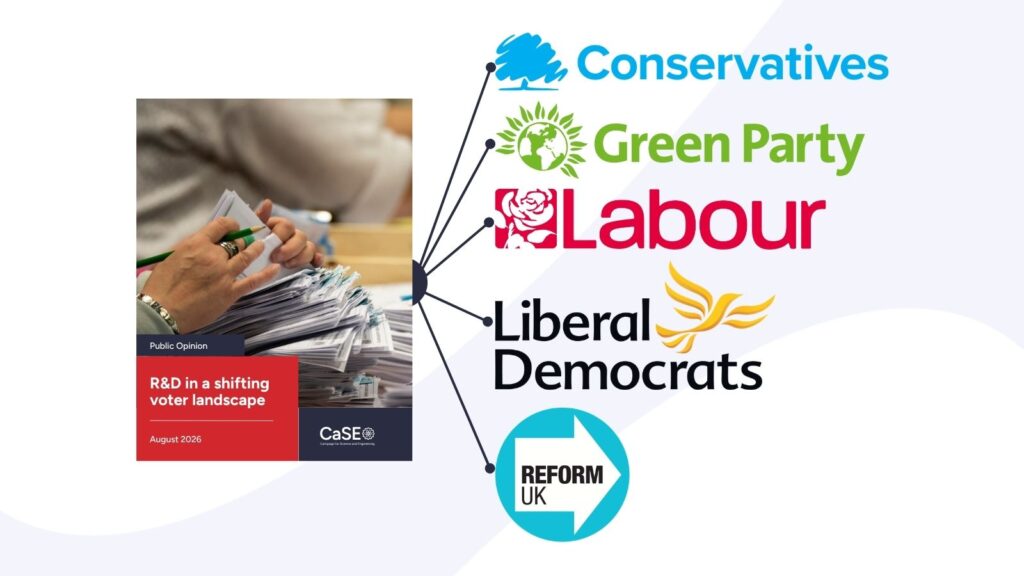
The project involved a desk review, analysis of existing CaSE public opinion research, qualitative research with 25 participants and a nationally-representative survey of 4,137 UK adults. The project focused on the following parties as having each polled at more than 10% at the point of project inception in 2025: Conservatives, Greens, Labour, Liberal Democrats and Reform UK.
The research evidences a new political cleavage that moves away from class and towards culture, with challenger parties emerging as a symptom of this fragmentation, rather than its cause. Voters are united by pessimism, with a shared diagnosis of the problems the country is facing, despite being divided by the causes. R&D benefits from broad public support, but this is both shallow and fragile. Although R&D is not yet a politicised issue, the risk is not hypothetical; we can’t assume the instinctive public support for R&D would survive a compelling political narrative.
This briefing series draws primarily on results from the quantitative research to summarise attitudes within each of the five main voter groups. To read the full results from the project and CaSE’s recommendations, see the report R&D in a Shifting Voter Landscape.
Throughout the reporting, vote intention figures are referred to. These are drawn from our own general population survey and are not the output of a dedicated political opinion poll. They should not be compared directly with, or read alongside, published voting intention polls. Unlike polls conducted by British Polling Council (BPC) member organisations, our figures have not been adjusted for a respondent’s certainty or likelihood to vote, for known patterns of differential non-response by political affiliation (sometimes termed “shy voter” effects), or rebased to exclude “don’t know” or “would not vote” responses, as is standard practice for headline voting intention polling. We use this question to segment our sample by political affiliation for analysis, not to estimate election outcomes.

R&D in a Shifting Voter Landscape
Explore the projectRelated resources

CaSE evidence to the Commons Science and Technology Select Committee
01 October 2026
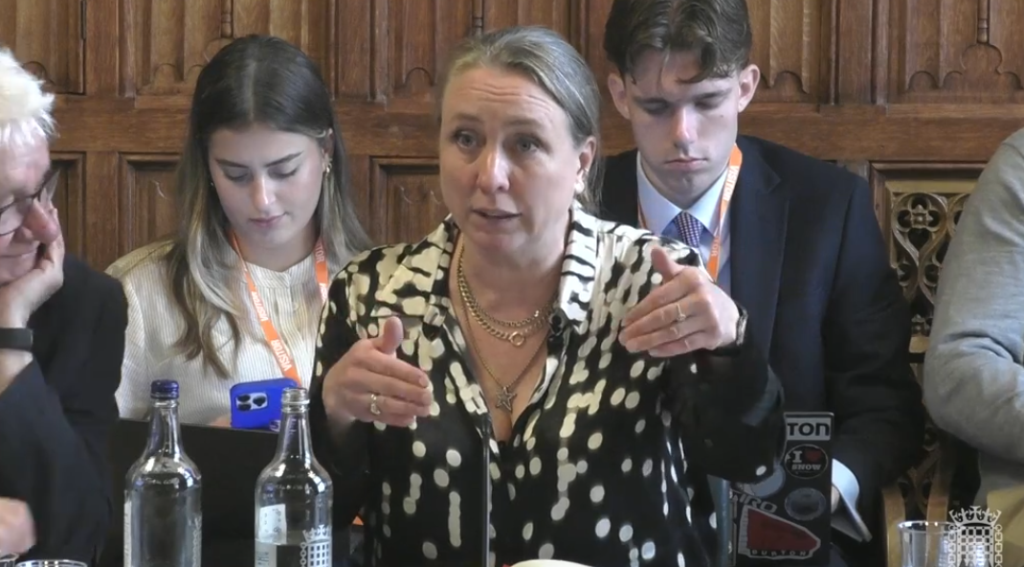
On September 15th CaSE Executive Director Alicia Greated gave evidence to the House of Commons Science and Technology Committee on the recent machinery of government changes.


R&D in a shifting voter landscape
27 August 2026
This report explores how changes in the UK’s political landscape could impact R&D.

Burnham Government statement on increased English devolution
06 August 2026
CaSE looks at the devolution plans and what they might mean for UK R&D.

Public Attitudes to R&D in Wales 2026
08 July 2026
This briefing summarises attitudes to R&D in Wales. It is based on evidence from a nationally representative survey of 1,626 adults (16+) in Wales in January 2026.