An update on members of the House of Lords Science and Technology and the board of POST
New Lords S&T Committee and POST members announced
05 Jun 2015
The new Members of the House of Lords Science and Technology Committee have been announced, along with a new appointment to the Board of the Parliamentary Office for Science and Technology(POST).
The Lords S&T Committee is a highly-respected panel with the power to closely examine any Government policy across all Whitehall departments where it involves science or technology. The Committee’s Members are often expert scientists and engineers themselves meaning the level of scrunity is extremely high. There are a lot of new Members this time around as a large number had to stand down due to the length of time they had served on the Committee.
New Members:
Lord Cameron of Dillington (Crossbench)
Lord Fox (Lib Dem)
Lord Hunt of Chesterton (Lab)
Lord Kakkar (Crossbench)
Lord Maxton (Lab)
Baroness Morgan of Huyton (Lab)
The Duke of Montrose (Con)
Baroness Neville-Jones (Con)
Lord Vallance of Tummel (Lib Dem)
Returning Members:
The Earl of Selborne (Con) (Chairman)
Lord Hennessy of Nympsfield (Crossbench)
Baroness Manningham-Buller (Crossbench)
Lord Peston (Lab)
The Viscount Ridley (Con)
POST is Parliament’s in-house source of scientific advice, providing easy to access information on a diverse range of public policy issues to MPs and peers. It’s Board is made up of MPs, peers, and external experts, and guides the office’s outputs, reports, and work programme. POST’s Director, Dr Chris Tyler, is also a Trustee and Board Member of CaSE.
New POST Board Members:
Earl of Selborne (Con)
Returning POST Board Members:
Professor the Lord Winston (Lab) (Vice-Chair)
Lord Oxburgh (Crossbench)
Lord Haskel (Lab)
Related resources
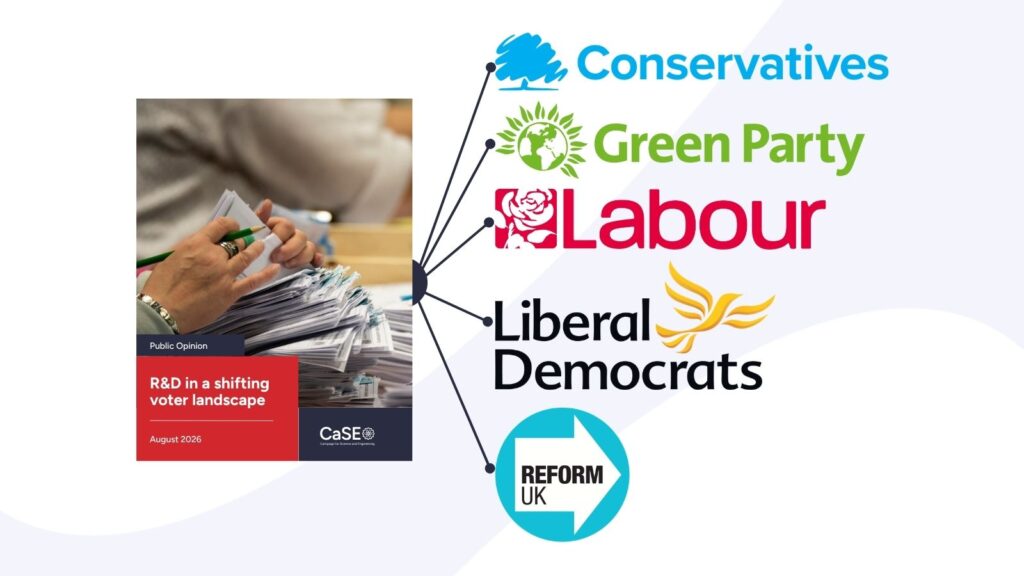
What does CaSE’s flagship study, Public Attitudes to R&D 2025, tell us about voter attitudes and how they differ? Rebecca Hill takes a look at the evidence and how this will inform CaSE’s new project R&D in a shifting voter landscape.
Analysis of ‘high-level mapping’ of the new UKRI ‘buckets’ system and what they tell us about UK R&D funding.
Following discourse surrounding UKRI’s new funding model and the specific impact of some changes to the STFC, CaSE have written to ask for further clarity on some key areas.
In the last few days CaSE have had multiple opportunities to hear from and have discussions directly with UKRI’s CEO Prof Sir Ian Chapman.