With high turnover expected at the May 2026 Scotland and Wales elections, many of the newly elected members of Scottish Parliament (MSPs) and members of the Senedd (MSs) will be coming into office with different priorities for, and understandings of, R&D.
Building on the success of our work around the 2024 UK General Election, CaSE will be sending all MSPs and MSs a Welcome Pack highlighting the breadth of R&D across Scotland and Wales. We want to showcase local R&D and urge MSPs and MSs to engage and see it in action. Alongside R&D examples tailored to their constituency or region, each booklet will include statistics about constituents’ attitudes to R&D based on new polling CaSE will carry out in early 2026.
2026 Holyrood and Senedd elections
Read more about the projectSubmit a case study by the 20th February 2026:
We are asking our members and the wider sector for examples of the people and places doing R&D in Scotland and Wales. This is a fantastic way to showcase the benefits of your R&D to the new cohort of MSPs and MSs.
We welcome case studies about the work carried out by your whole organisation, a single site, partnership or member organisation, or about a specific research project with ties to Scottish or Welsh communities. (You can see an example of the 2024 General Election Welcome Packs below.)
These case studies will be featured in Welcome Packs and/or on the CaSE website, and run alongside a call for MSPs/MSs to visit or engage with the initiatives showcased.
Please use this form to submit the details of an R&D case study connected to Scotland or Wales that you would be happy for CaSE to use in our advocacy work.
Submission guidelines:
- Case study title: 50 character limit (approximately 4-8 words)
- Type of R&D (broad area/field): 40 character limit (approximately 4-6 words)
- Text: (600 character limit; approximately 80-100 words)
- Image (if submitting): High resolution landscape image you have the right to share with us, showing the location or indicating the type of R&D occurring.
Choosing your case study: Where possible, please highlight details that will resonate with parliamentarians. This could be:
- Economic and/or societal benefits of the featured R&D for local areas, communities or regions
- Examples of inter-disciplinary or inter-organisational collaboration
- Job creation, and training and employment opportunities
You are welcome to submit more than one case study. We are hoping to achieve strong representation across all regions in Scotland and Wales and so we would particularly welcome submissions that are connected to regions that do not have major R&D sites, for instance remote or rural areas.
We will be producing a Welsh language version of the booklet for MSs. If you are submitting a case study for Wales and would like to include your own translated version in Welsh, you will be able to do so as part of the submission form or via a follow up email. Any case studies selected for print that have not had a Welsh counterpart submitted by the deadline will be translated by CaSE, with no further approval possible.
What will the case studies and Welcome Packs look like?
Welcome Packs will include an introduction to R&D, constituency level statistics, and short case studies that highlight the breadth and depth of R&D carried out across Scotland and Wales.
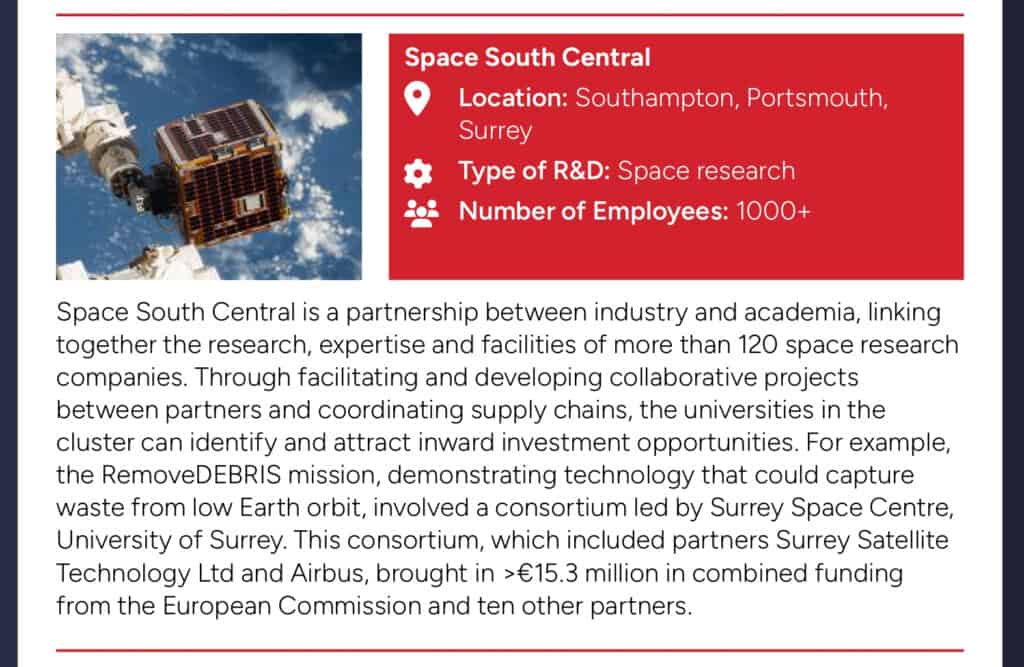
Here is an example case study included in MP Welcome Packs for the General Election in 2024. All previous MP Welcome Packs, and the full database of case studies submitted last year can be found on our MP Welcome Pack page.
Contact info
If you have any questions, please contact project lead Florence Young (florence@sciencecampaign.org.uk)