
Ben Bleasdale
Director of Public Opinion

Daniel Rathbone
Deputy Executive Director
Evidence suggests the voter landscape has fragmented since the 2024 General Election, with five parties currently polling at greater than 10%, and the Green Party and Reform UK notably expanding their voter bases. Significant changes are anticipated at the ballot box in the devolved and mayoral elections in May 2026.
For advocacy professionals across the R&D sector, this fragmentation poses a new challenge for our work. Our current advocacy messages and tactics were fine-tuned for an era of relatively reliable cross-party support for R&D. Over many years, while there have been different visions for the sector and how it operated, this was underpinned by a broadly shared belief in the value of R&D brings to society. In a new era of politics and political priorities, we can’t rely on outdated assumptions and advocacy messages.
CaSE’s recent public opinion research indicates that prospective Reform voters are less supportive of R&D investment, while those intending to vote Reform or Green are more likely to feel R&D’s benefits aren’t felt equally across society. And levels of connection with R&D and its benefits are worrying low across the whole voter base. If our sector doesn’t take time to understand the views of those who are feel more distant from R&D, we risk being caught off guard in a similar way to the Brexit referendum.

R&D in a shifting voter landscape
Explore the projectBroad but shallow support
Last November, CaSE published our landmark Public Attitudes to R&D 2025 study, exploring public attitudes across a nationally representative sample of 8,000 UK adults. The findings offer a stark warning – while support for R&D is broad, it is dangerously shallow.
On the surface, the numbers look promising – 88% of the public say it’s important for the UK government to invest money in R&D. However, beneath this surface-level approval lies a disconnection between R&D and society that threatens the sector’s long-term political security.
CaSE’s data shows that less than a third of people feel personally connected with R&D, and just 18% can immediately think of lots of ways it benefits them or their families. In a political climate defined by pessimism – with 62% agreeing that the UK is in decline and just 39% feeling optimistic things will get better – this lack of connection is a huge risk. If voters don’t see R&D as relevant, or as something that can bring tangible, personal benefits, we can’t expect them to defend it – or support those who do – if the political tide turns.
“I struggled to connect R&D to benefits felt by ‘me’ – I know what R&D is, but I could not relate it to my life”
Female, 25-34, Clacton, C1
Navigating a new landscape
Robust evidence is needed to help R&D organisations to prepare for, and navigate, a fragmenting political landscape. We must move beyond generic messaging and start landing the right messages at the right moments with the right audiences.
To help fill this gap, CaSE is launching a new project: R&D in a shifting voter landscape. This will be an evidence-led review exploring how shifts in the full breadth of the voter landscape might affect R&D advocacy, providing practical insights for R&D advocates to use through the 2026 party conferences and beyond.
The core part of this project will cast a wide net for relevant public and political data – combining CaSE’s existing catalogue of evidence with wider sources from across and outside our sector. These combined insights will be used to design a new qualitative research programme exploring the range of voters’ concerns and motivations, and develop practical advice for the R&D community to be published in the early autumn.
We’ll be keeping CaSE Members updated as the project progresses:
February
Call for evidence to CaSE members and other R&D organisations to identify knowledge gaps and collate a library of relevant data sources.
March
Evidence analysis to extract relevant insights for R&D advocacy and identify factors, themes and issues shaping voting patterns.
April
Co-creation workshop to digest the analysis and collaboratively identify the factors, themes and issues we want to prioritise for fieldwork.
May
Core fieldwork to qualitatively explore voter concerns and motivations
September
Launching a report on the key drivers for R&D among voters, anticipated positioning of political parties, and practical messaging guidance.
Expanding on this core project funded via CaSE’s grant from the Wellcome Trust, we’re seeking partners to sponsor and shape ‘deep dives’ into polarising issues or risks which might undermine the sector’s messaging and political advocacy. These issues will be identified by the partners, but might explore how R&D intersects with voter opinions towards topics such as immigration, NIMBY-ism or national security.
Each deep dive will involve new large-scale polling of the voter base to test messaging, explore counter arguments and yield practical insights to help navigate these challenging topics. These deep dives would be combined into the overall report published in September, providing insights to help inform engagement through the 2026 party conference season and beyond.
Getting involved
We are inviting all R&D organisations to engage with our call for evidence, by highlighting relevant data or insights that we should draw into review process – whether that’s from your own organisation, or external sources you’ve found helpful.
CaSE also invites potential deep dive partners to get in touch with CaSE to explore which topics might help your organisation navigate the advocacy landscape ahead.
As a sector, we cannot afford to let R&D become a casualty of political fragmentation. By understanding voters better, our sector can evolve our messaging and tactics to keep R&D at the heart of the UK’s future.
Related resources


R&D in a shifting voter landscape
27 August 2026
This report explores how changes in the UK’s political landscape could impact R&D.
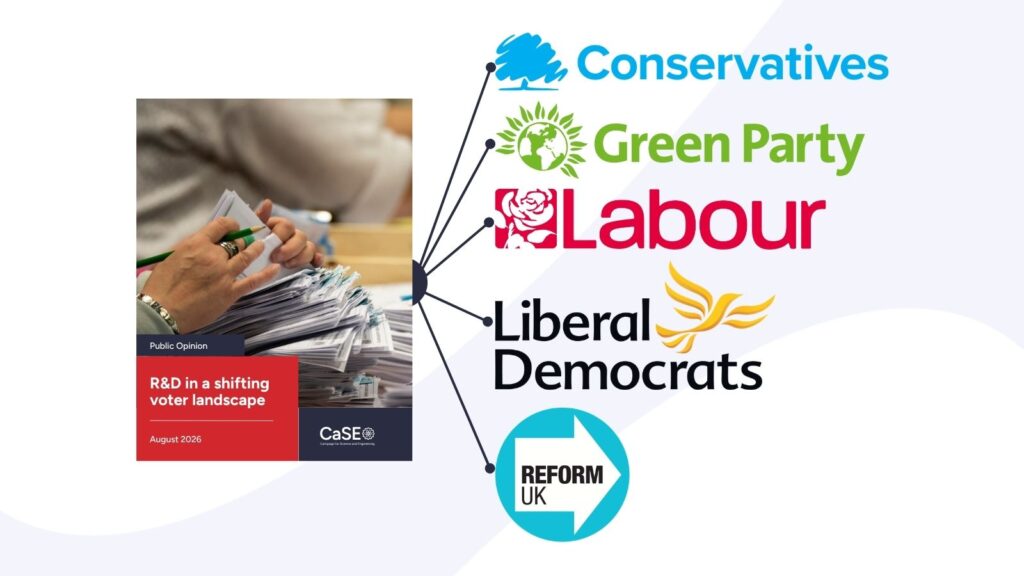
R&D in a shifting voter landscape: Voter group analysis
27 August 2026
This briefing series summarises attitudes within each of the five main UK voter groups and offers advice on how to better engage with them about R&D.


CaSE letter to Chris McDonald MP
11 August 2026
CaSE wrote to Chris McDonald in the new role of Minister of State Science, Innovation and Investment.


Burnham Government statement on increased English devolution
06 August 2026
CaSE looks at the devolution plans and what they might mean for UK R&D.