We are adjusting our review period to better align with our annual general meeting. This review is the culmination of addresses given by CaSE’s Executive director in 2024 and 2025.
In this review we cover the main topics CaSE has worked on this year.
Policy and Public Opinion combined
A key step change for us as a team and as an organisation this year has been the integration of our policy work, which we’ve been known for for many years, and our public opinion work. This year CaSE was awarded a new £2.7 million grant from Wellcome to expand our public opinion research.
Public opinion insights make our messaging to politicians more compelling and impactful. Early in 2025, we launched our refreshed organisational strategy. It sets a clear purpose and values and also combines our public opinion work with our policy work. We’ve used the strategy internally to create a clear framework for how we plan and manage our work, which makes us more streamlined and focused in what we do.

CaSE in 2025 – Director’s address to the AGM
Executive Director Dr Alicia Greated gives her report on CaSE’s activities and successes at the 2025 AGM on November 25th.
Read morePublic Attitudes to R&D
This year CaSE has carried out a series of in-depth pieces of work
‘People’s Vision for R&D: How to move from principles to action’
First was a deliberative dialogue, engaging closely with the public to create a society-centred vision for R&D. We published our report ‘People’s Vision for R&D: How to move from principles to action’ in September.
‘People and Places: How to put R&D on the map’
In November 2024 we published a significant study ‘People and Places: How to put R&D on the map’. This explores how to use place to strengthen connections with R&D on a local level. I am proud to say it has received lots of interest and traction from MPs already – including Chi Onwurah, the new chair of the Science, Innovation and Technology Select Committee.
Public Attitudes to R&D 2025
In November 2025 we launched our landmark study, Public Attitudes to R&D 2025. This is a substantial piece of work that has received a lot of interest and attention. It builds on our previous public opinion work, and we have launched this major new study which will be repeated in 2028 to track attitudes to R&D over time.
To ensure we poll the most relevant issues, the team engaged extensively with our members and right across the sector before the summer. We spoke to 50 different organisations, making sure that we were asking the right questions in our polls because we know we’re going to be asking them again.
Working with our research partner ICARO we have now polled 8,000 UK adults and run 8 in-person focus groups across the four nations of UK. I got to sit in one of those focus groups in Edinburgh, and it’s absolutely fascinating hearing firsthand how the public feel. We also run 20 in-depth interviews with individuals as well.
The final report was launched at an event two weeks ago, with Julia Gillard, the Chair of Wellcome and previous prime minister of Australia. She was very enthusiastic about the work and has since talked about it at at least two other events.
There are lots of important and interesting findings, but the main thrust of the work is that public support for R&D is broad but shallow. There is support for investment into R&D, but society’s connection to R&D is worryingly weak, and many struggle to see or feel the benefits it brings.
Conference: Making R&D matter to more people’
‘Making R&D matter to more people’, was hosted at the Royal Institution in September 2024. Thank you to the many members who attended and helped make it an exciting and unique event. We were delighted to have great speakers and attendees, including the new Secretary of State for Science, Innovation and Technology, Peter Kyle – his appearance in the evening session, one of his first in post, certainly attracted a great deal of interest.
Annual Lecture 2024 with Ilan Gur
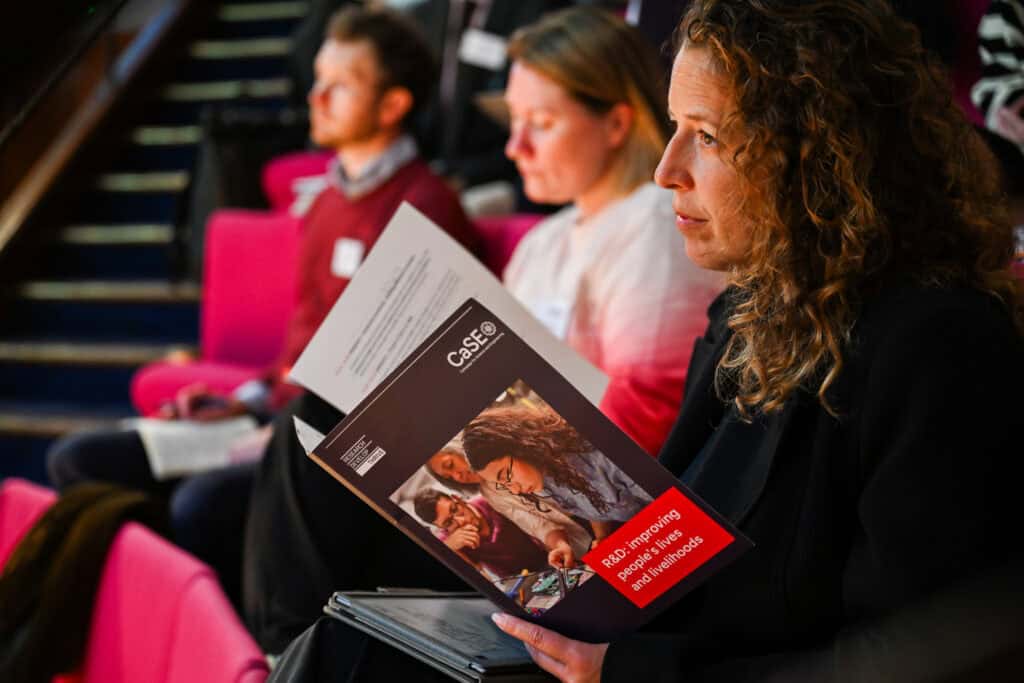
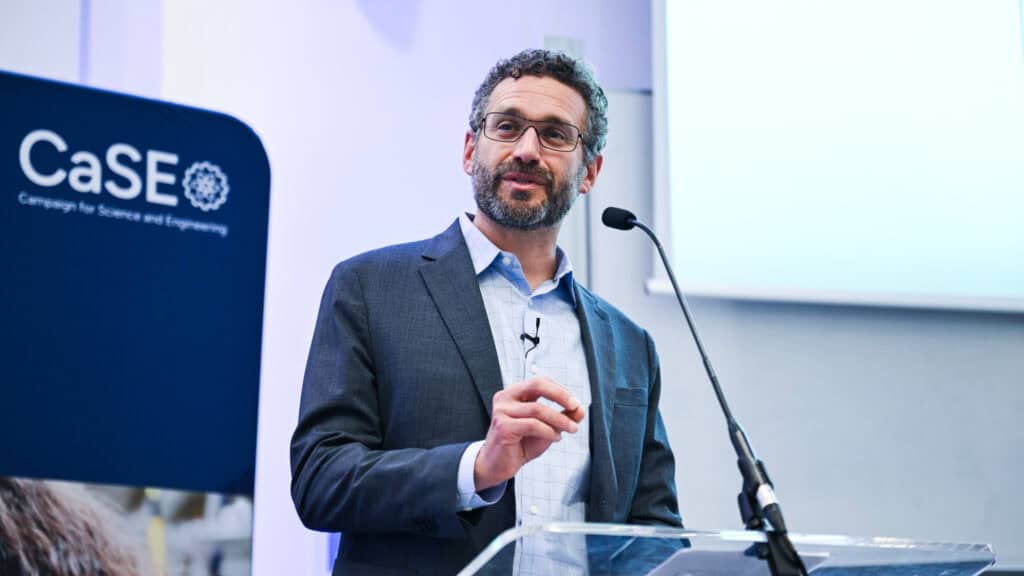
CaSE’s 2024 Annual Lecture was given by Ilan Gur, CEO of the Advanced Research and Invention Agency (ARIA) on December 12th.
Ilan shared how ARIA’s focus on empowering exceptional scientists is shaping its approach to breakthrough research. He was joined onstage by ARIA Programme Directors, Jacques Carolan, Jenny Read & Sarah Bohndiek, who discussed this vision in action, and how this ‘people-first’ philosophy guides them in designing and directing pioneering research programmes across the UK and beyond.
Investment
2024 Autumn Budget
In the run up to the budget we were made aware of the possibility of a flat cash settlement for the research budget, which may have had to cover extra ‘tucked in’ costs.
We responded rapidly to media requests, making the potential impact of this move on the sector very clear. Simultaneously, we coordinated a joint letter to the Chancellor. CaSE brought together 38 organisation in 24 hrs to sign that letter – which was widely reported in the media.
Following these efforts, we then worked with partners in the sector, and the media to keep attention on this topic – we coordinated a letter to the Times and supported an opinion piece and article in the Observer.
I am pleased to say that at the budget speech the Chanceller made it clear that “the UK’s science base is a crucial national asset.” She committed to ‘protecting’ Government R&D investment, with £20.4 billion allocation to R&D in the next financial year.
The contents of the Budget were generally a good outcome for the R&D sector. However, the devil is in the detail.
We are still monitoring and working out the details of the budget as they develop, and very much have our eyes on the next stage, the spring spending review.
We have seen the power of bringing together our policy advocacy and public opinion work – this has gathered pace and support from across the R&D sector. We feel we are giving a unique perspective and insight that is having real impact.
Spending Review
We were highly active in shaping the Spending Review. Our formal submission was developed through extensive discussion with members. It set out clear recommendations on areas including public investment, regional growth, research sustainability
We provided intelligence and advice to our members to help them advocate. We have also updated our internal modelling tools so that we could rapidly analyse the impact of the final settlement on public R&D investment. The reason I wanted to mention that is the team, as you’ll know, provided a brilliant briefing to our membership to explain the impact of the spending review.
When we talk to our members, when we talk to our partners, people really value those analyses and briefings. You all know when you get a very long government document of potentially hundreds of pages, our team will look at that, analyse it, synthesise it and pull out the relevant issues for the community.
Economic analysis
Another key highlight was the publication of the economic analysis report we caried out in partnership with the British Academy, this has been an ongoing piece of work – published in July.
We co-commissioned a report by Cambridge Econometrics which looks at the economic return of UK R&D. It looked at ten different technologies and where the UK captures value as well as the barriers in each sector.
Our joint briefing based on the report, Mapping the Economic Returns of R&D, has been shared widely and discussed across government.
Long-term budgets for R&D
In May this year government published guidance on ten-year R&D budgets. We were pleased that many of our recommendations were explicitly adopted. These recommendations were based on a roundtable we ran with representatives from across the UK R&D sector including treasury and DSIT, funders and recipients of large grants. At those roundtables, we looked at the opportunities, but also the real challenges of long-term investment.
This is an example of CaSE influencing the structure of UK R&D support for the long term.
Government Missions
Firstly, we worked on key political milestones. As I’m sure that you’ll all be aware, the government launched, and were talking a lot about, their missions early in the year. We also had the major fiscal event, the spending review.
A really important piece of work this year has been helping the government, and also the broader sector, understand how R&D can support the government missions. We went to Cambridge, Bath, Manchester, Edinburgh, to talk to our members and our partners to gather evidence so that we could explain and describe how R&D can contribute to the missions.
This work fed directly into our Mission Critical R&D report, which integrates not only policy evidence but – for the first time – public attitudes data on the missions. The report was well received and recognised by Treasury and DSIT – and it fed into our spending review submission.
Challenges for Universities
One of the key challenges for the sector this year has been the financial pressures on universities.
Universities have been facing acute financial stress this year. We worked with Universities UK (UUK), and through one of our board members, the Association of Research Managers and Administrators (ARMA) to publish a briefing, Research at Risk.
This report highlights how financial pressures are already shrinking research capacity in the UK. Our evidence was circulated by the Education Select Committee ahead of its April hearing on university funding.
Immigration and talent
The other theme around immigration and talent is something we’ve been working on for a number of years now. It was a significant focus in the last year.
This is a big challenge for the sector given the importance of international researchers’ contributions in the R&D process, and the very sensitive political debate we have at the moment around immigration.
We did a number of activities. We coordinated a cross-sector letter with 36 other organisations to reach targeted MPs ahead of the Immigration White Paper
We also produced a major evidence-based briefing on visa barriers, including testimonials from 15 research organisations. It’s very hard to get that type of evidence because people don’t want to talk about it. We’re proud of that piece of work and have had lots of good feedback on its impact.
Alongside this we developed a new communications guide on how to speak about researcher immigration in ways that genuinely resonate with the public, especially those with more sceptical views. As you can imagine that’s a very live issue at the moment.
I think that’s another great example of how we’ve used public opinion work deeply in our analytical policy work. We brought those together to create a strong message that’s definitely working.
Related resources


CaSE in 2025 – Director’s address to the AGM
02 December 2025
Executive Director Dr Alicia Greated gives her report on CaSE’s activities and successes at the 2025 AGM on November 25th

Reflections on an exciting nine months
17 December 2024
Lynne Milford reflects on her time as CaSE’s Campaigns and Public Affairs Manager.

CaSE in 2024 – Director’s address to the AGM
04 December 2024
Executive Director Dr Alicia Greated gives her report on CaSE’s activities and successes at the 2024 AGM on November 26th.

CaSE 2023-24 Annual Review
29 October 2024
This year has seen changes to CaSE as an organisation, shifts in the UK political landscape, and important developments for the UK R&D sector.