Forewords
Dr Alicia Greated, Executive Director, CaSE

2026 has been another significant and productive year for CaSE.
In an environment of political shifts, economic pressures, and a changing R&D landscape, we have continued to strengthen our voice, influence policy and champion the importance of R&D.
This year we celebrated an important milestone – the 40th anniversary of CaSE. This provided a chance for us to celebrate CaSE’s contribution over four decades, and bring together voices from across the sector to look ahead to the future opportunities and challenges for UK R&D. CaSE was originally founded by a group of scientists who were increasingly frustrated by declining research investment, the loss of research capability and the brain drain of talented scientists overseas. As part of our celebrations, we were delighted to welcome one of our founders, Professor Denis Noble, to our annual conference, providing an important reminder of the need for an independent organisation to represent the R&D sector, and a fantastic opportunity to reflect on how far the organisation has come.
CaSE’s influence and reach have continued to grow. We have been closely involved in influencing and analysing important developments in the R&D landscape, including the introduction of UK Research and Innovation’s (UKRI’s) new funding model and changes to government departmental structures and priorities. Our engagement with ministers, senior officials, UKRI, and Parliament, including giving evidence to the House of Commons, has allowed us to represent our members at a time of considerable change.
This year we worked on a range of important and impactful projects bringing together our policy and public opinion expertise. We have explored the future of UK R&D and delved into changes in the political and voter landscape. We were very grateful to the sponsors that made it possible for us to deliver our work on the Devolved Nation Elections to raise the profile of R&D and build stronger connections with politicians in the Scottish Parliament and the Senedd. Our significant work on the public’s opinion of R&D has attracted a great deal of attention and has helped bring a much-needed awareness of the importance of the public’s perspective into how we carry out UK R&D.
We have also worked hard to strengthen our internal systems, processes and ways of working, to build a more effective and resilient organisation. We have designed and introduced new analytical and reporting tools to enhance the management of, and engagement with, our CaSE members. We are also in advanced stages of a project to improve our HR support and staff benefits. Overall, this has resulted in the CaSE team being more coordinated and efficient and we will continue this work next year.
The effective Governance of CaSE is critical for our success. This year we will see some significant changes to our Board. We will say goodbye and a heartfelt thank you to our Chair, Prof Bob Sorrell, and four of our trustees. We also look forward to welcoming a new Chair and Board members in the coming year. Together we will continue to ensure that UK R&D is recognised, valued and supported for the benefits it brings to lives, livelihoods, and the UK’s future.
I want to finish by saying some important thank yous. We are enormously grateful to our CaSE members, without whom none of our work would be possible – in particular City St George’s, who generously host us in their offices, and the Wellcome Trust, who support our public opinion work via a grant. We are a small team and are dependent on working in partnership across the R&D sector and are thankful to those organisations and people who have supported us. Finally, none of our achievements would be possible without the knowledge, energy and commitment of our excellent team at CaSE who I very much look forward to working with as we go forward.
Prof Bob Sorrell, Chair, CaSE

It is vital that any charity or mission driven organisation takes the time to reflect on its journey and look to the future. This year, CaSE’s 40th anniversary, gave us a superb opportunity to consider our successes over the decades and turn our focus to what the future holds for UK R&D.
As part of our celebrations in February, I had the pleasure of sitting down with one of CaSE’s forerunner Save British Science’s founders, Prof Denis Noble. Denis provided great insight into the challenges the sector faced in the 1980s and 90s and offered his views on any similarities we face today. I encourage anyone who has not watched the discussion to take the opportunity to do so.
My discussion with Denis, and the thought-provoking contributions from across the day left me firmly believing that CaSE is an organisation that is as needed and relevant today as it was 40 years ago. CaSE’s membership has changed and grown in the intervening years; however, it remains true that our members, who represent the breadth of UK R&D, need CaSE. They need CaSE to be a voice that champions R&D, they need CaSE to have its ear to the ground in a shifting political landscape, and they need CaSE to bring the sector together behind our common goal; To advocate for UK R&D, for the benefit of lives and livelihoods.
As my time on CaSE’s board and as chair comes to a close this year, I have also reflected on my own experience as part of CaSE. It has been a privilege to help steer the charity and support the team over the last 12 years, and I will miss seeing behind the scenes of the fantastic work they continue to do. I would like to thank all of the trustees I have served alongside and had the pleasure of chairing. It is the voluntary and committed effort of these people that underpins the work of any successful charity. I know I echo the sentiment of the staff when I greatly thank the four trustees who have finished their terms this year.
Lastly, I would like to thank the CaSE staff I have worked with over the years, including Sarah Main and Alicia Greated as Executive Directors, for their diligent and expert work. I wish them all every success as they continue to champion UK R&D.
A milestone year for CaSE
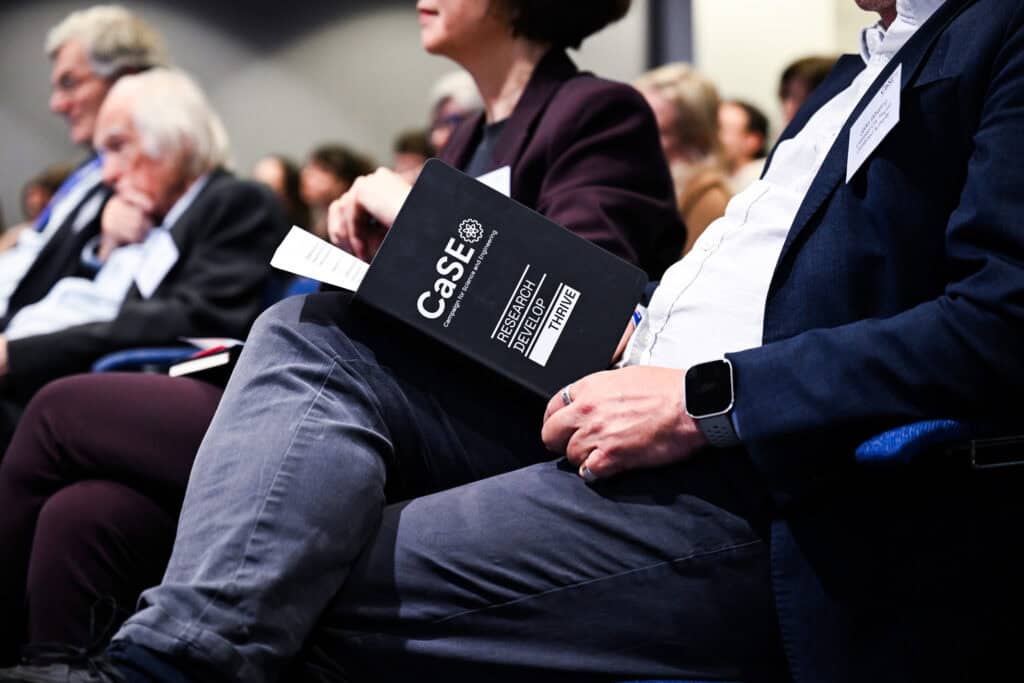
CaSE’s 40th Anniversary Conference
As both the global and national picture for R&D continues to change, CaSE celebrated 40 years of advocacy by looking at what the future might hold for the sector.
Our 2026 conference brought together people from across the sector and beyond to hear panels of experts discuss the important issues facing UK R&D, and to ask questions to key figures influencing the future of the sector. Our thanks to CaSE members the Institute of Physics and Elsevier for hosting and sponsoring the event respectively.
We were very proud to begin the day with a conversation with Denis Noble, founding member and ex-chair of Save British Science (now CaSE). In conversation with current CaSE Chair Robert Sorrell, the two spoke about the reasons for founding Save British Science in 1986 and how the origins of CaSE connect to the conversations and issues we face today.
The conference also included sessions on how the sector can utilise an understanding of public opinion to shape its future, and how the sector can rise to face the challenges of an increasingly uncertain future. The afternoon concluded with a keynote lecture from Professor Sir Ian Chapman, CEO of UKRI, followed by a networking reception.
It was fantastic to bring together such a well-received event, with attendees and members commenting on the network and connections CaSE’s activities offer.

CaSE Conference 2027
Registration is now open for CaSE’s 2027 Annual Conference on February 9th, hosted by the Institute of Physics and sponsored by Elsevier and City St George’s, University of London.
Register to attend“CaSE does a really good job convening stakeholders from across the R&D sector – research intensive universities, government research facilities, industry – and bringing together all the various constituent parts of the R&D system” –
Andrew Gill
University of Surrey
Our membership
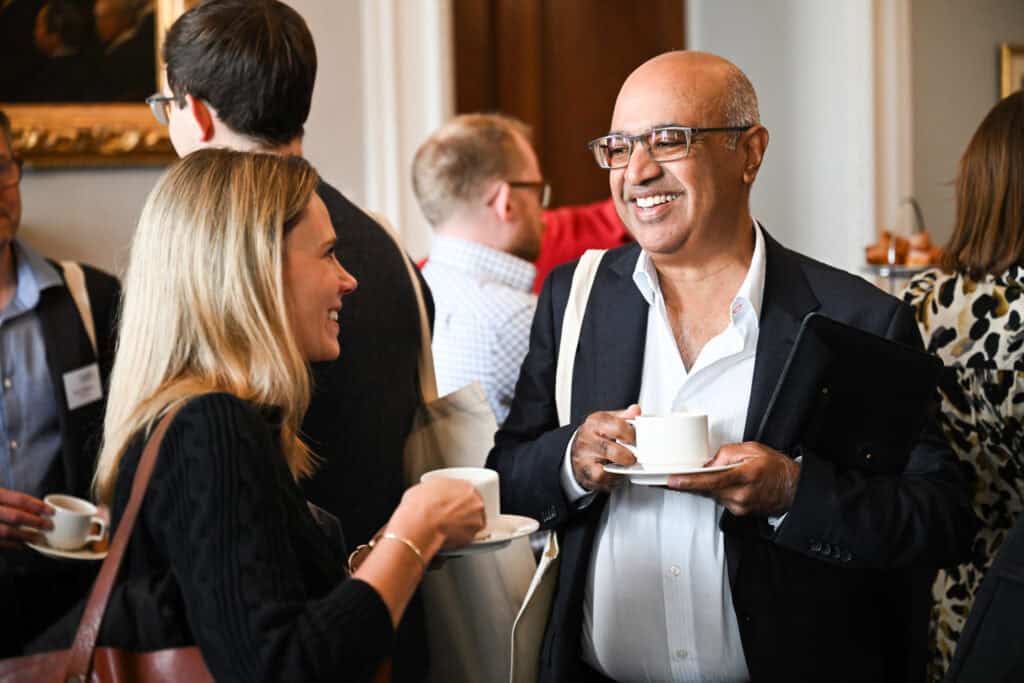
Joining CaSE
Members continue to sit at the heart of CaSE’s work and advocacy, and we’ve been excited to bring in both new and returning voices to our work.
This year we were proud to be joined by the following organisations:









We look forward to working with both our new and long-standing members as we plan our work for the coming years.
Making it easier to engage
Already this year we’ve engaged across the whole of the CaSE membership, helping to bring the voice of our members to the forefront of our work. We’ve been working to continue our efforts travel to members across the UK, with more of our events and meetings taking place outside of London.
Over the past year we have also been working on improving the operation and processes that support CaSE membership. We have been working with our relationship management database, creating the functionality we need to better track and gather insights on our work, events and other activities.
We are excited these new processes will support our work in a range of ways, from giving us more time to be face to face with members over to supporting us to better tell the story and impact our work is having.
“What is really great about being a member of CaSE is how you have a treasure trove of information that you always pull together and we can pull upon”
Lucy Wilson
UK Dementia Research Institute
A year of changes

UKRI funding structural changes and cuts to the STFC
We have played a prominent scrutiny and advocacy role regarding UKRI’s new “buckets” funding structure. CaSE analysed the initial UKRI budget allocations published in December 2025, welcomed greater long-term visibility of R&D investment, but raised concerns that the new funding framework made it difficult to compare future allocations with previous funding arrangements, limiting transparency and external scrutiny.
CaSE consistently pressed UKRI and government to provide clearer explanations of how funding is classified across the new buckets, particularly the definition of “curiosity-driven research” and argued that robust historical comparisons were needed to assess claims that such research was being protected. In March 2026, CaSE welcomed UKRI’s publication of a “high-level mapping” of the buckets system as an important first step towards greater transparency, while continuing to call for clearer definitions, fuller data and ongoing accountability as UKRI implements the new structure.
Alongside this, CaSE scrutinised UKRI’s response to rising costs at the Science and Technology Facilities Council. In February, we asked why cuts were presented as the only option for managing rising costs, rather than additional funding, a combination of the two, or reprioritisation elsewhere in UKRI, and noted that no explanation had been given for choosing cuts alone. When the outcome of the prioritisation was published in July, our analysis cautioned that the substantial cuts to multidisciplinary facilities and other research infrastructure would likely have a profound negative impact, with long-term economic and research costs exceeding the short-term savings. We then examined the outcome in the context of the new UKRI strategy and its 2026-27 delivery plan, continuing to hold decisions to account as they moved from announcement to implementation.
Championing R&D in the 2026 devolved elections
The 2026 Holyrood and Senedd elections came amid a shifting political landscape; there was an urgent need to proactively engage all new parliamentarians and positively influence their attitudes towards Scotland and Wales’s R&D sectors. To support the sector’s advocacy, CaSE conducted new polling of public attitudes to R&D in Scotland and Wales in 2026 at an unprecedented depth. The resulting national- and constituency-level public opinion insights were shared with 755 election candidates in bespoke emails and 225 elected parliamentarians through physical Welcome Packs, urging and equipping them to help R&D thrive.
As part of this campaign, CaSE has been engaging with devolved policy areas that will impact on R&D both in the nations and across the UK. Ahead of the May 2026 elections, CaSE analysed what the manifestos of the leading parties in Scotland and Wales could mean for R&D, finding promising recognition of the value of research and innovation, and the strengths of R&D institutions, in various contexts throughout the range of manifestos.
CaSE also held two virtual workshops in April, one in each nation, to support the development a set of holistic policy asks of the new cohort of Members of the Senedd (MSs) and Members of the Scottish Parliament (MSPs). The asks appeared in the tailored Welcome Packs for MSs and MSPs setting out actions they can take to help support R&D in Wales and Scotland, respectively.
In addition to supporting engagement with the devolved governments, helping CaSE secure meetings with both the devolved minsters who hold the R&D brief for their nation, this campaign allowed us to engage with politicians across the political spectrum. Overall, CaSE received responses from 19 elected parliamentarians and has so far secured meetings with nine of these (four MSPs, five MSs). This includes meetings held with shadow spokespeople for R&D from political parties across both Scotland and Wales: David Kirkwood MSP (Reform UK Scotland), Jenny Young MSP (Scottish Labour) and Sam Rowlands MS (Welsh Conservatives).
This successful campaign was made possible by the support of our project sponsors: Cancer Research UK (CRUK), British Heart Foundation (BHF), UK Centre for Ecology and Hydrology (UKCEH), Cardiff University, Compound Semiconductor Applications (CSA) Catapult, University of Edinburgh, University of Glasgow, and University of Strathclyde.
A new UK Government
On 20th July, Andy Burnham was appointed Prime Minister bringing with him a new Government and the creation of the new department for Business, Innovation, Science and Trade (BIST), merging the science brief from the Department of Science, Innovation and Technology (DSIT) with the Department for Business and Trade (DBT). CaSE engaged closely on these developments, communicating to our membership and the wider sector what the changes mean for R&D.
CaSE wrote to the Prime Minister, the new Secretary of State for Business, Innovation, Science and Trade, Jonathan Reynolds, and the new Minister of State Science, Innovation and Investment, Chris McDonald. Our Executive Director, Alicia Greated, engaged with Jonathan Reynold’s directly at his first call with R&D sector representatives in late July, and gave oral evidence at the 15 September 2026 House of Commons Science and Technology Committee session about the risks and opportunities of the machinery of government changes for the R&D sector.
Immigration
Visas and immigration have continued to be a priority for CaSE over the past year, with a focus on engagement and dissemination following the publication of key pieces of work. In February the then Chancelor Rachel Reeves spoke at the Davos announcing measures on global talent, CaSE Deputy Executive Director Daniel Rathbone analysed the developments. We also submitted evidence to the Home Affairs Committee inquiry: routes to settlement and met with the Global Talent Taskforce to share evidence.
CaSE has been monitoring developments around visas and immigration. As part of which we submitted a representation to the Home Office consultation “A fairer pathway to settlement”. In November 2026 the Government confirmed the final proposals on earned settlement, which are expected to take effect in 2027. Under the new proposals Global Talent visa holders are placed on a 3-year settlement track. Skilled Worker visa holders earning under £50,271 will now face a 10-year route to settlement (up from five years currently) and no transitional arrangements for existing holders are expected to be put in place. We will be assessing what it means for researchers and the wider research workforce.
In November 2026 we saw the publication of the MAC review, which CaSE contributed to by attending a roundtable. It is positive that its conclusion is that the Global Talent visa is largely functioning well, although with some scope for improvement. We will be keeping an eye on the implementation of the recommendations, including the practicalities of minimum earnings requirements at settlement and changes to endorsement operations.
Building our evidence base

Reimagining R&D
Over the last year, CaSE convened its members and the R&D sector to think about a future vision for UK R&D. We believe that the sector and the Government must take a longer-term, strategic view. In a changed and changing world we need to answer the question: How can the sector better position itself to meet future economic, societal and strategic challenges?
‘Reimagining R&D’, published earlier this year, sets out the sector’s view on what the R&D system should look like in 2045. CaSE also carried out a deeper exploration of the vision through a series of roundtables with our members and the sector. The conversations considered the current policy environment, where we are now, and what is needed to take things forward.
We distilled this into four actions to get to a more resilient future across these different areas. These are actions the sector and the Government can already be taking:
- Nurture and strengthen the foundations of the R&D base,
- Provide sustained support and continuity,
- Prioritise and be more strategic to compete globally,
- Make the R&D sector more visible and clearer about its value.
This work’s overarching look at some of the big issues facing the sector, now and in the future, has been of great use to CaSE and our decisions about where to focus next.
One of the first examples of this is CaSE’s recently published R&D in a shifting voter landscape report. It has explored domestic political fragmentation and what this could mean for the future of R&D advocacy.
The shifting geopolitical landscape has emerged as a priority issue facing the sector. CaSE is planning to explore this issue in more detail through a project looking at international research collaboration and what this looks like in the new geopolitical era.
R&D in a Shifting Voter Landscape
In February, CaSE launched a major evidence-led review of how the fragmenting voter landscape might affect R&D advocacy. The project generated practical insights and messaging for R&D advocates to use through the 2026 party conferences and beyond.
The project produced a major report and series of voter group briefings, which described a fragmented electorate facing economic insecurity and deep cultural anxieties. Voters are united by pessimism, centring on a “Broken Britain” narrative”, and immigration is emerging as a dominant dividing line between voter groups. These feelings are not confined to one party’s supporters, although there are differences on the causes and solutions. R&D continues to enjoy broad public support, and is often a source of hope – however, the consensus around R&D is shallow and divisions appear around specific issues.
The project has been warmly received by the sector and covered in specialist media – further reinforcing CaSE’s credibility as a politically neutral, evidence-led voice. With the possibility of an early General Election back on the cards, CaSE is seeking to expand this report with a series of ‘deep dives’ into the range of politically polarising that R&D advocates will need to navigate in the coming months and years.
Public Attitudes to R&D in Scotland and Wales
In January 2026, following extensive consultation with project sponsors and wider stakeholders to help develop our questionnaire, CaSE’s conducted new polling exploring public attitudes to R&D in Scotland and Wales.
The results were developed into a full report and write up, published in late March. We received a warm reception to the launch from sponsors and the wider sector, including through a well-attended and interactive webinar and Q&A session. We used the insights to develop two new Guides to R&D on the Welsh and Scottish Doorstep, urging Holyrood and Senedd election candidates to start conversations about R&D in their communities.
In July we shared the research findings with 225 elected parliamentarians and published two nation-specific data briefings on the underpinning public opinion research carried out in Scotland and Wales.
Since publication of the results in March, CaSE has been engaging extensively with sector stakeholders, reaching new audiences across the UK. We have met with and discussed the research findings and wider project with many influential and senior figures from across public, charity, and private sectors, as well as members of the public.
Public Attitudes to R&D 2025 Briefings
On 11 November 2025, CaSE published our landmark study, Public Attitudes to R&D 2025 (PARD25), which took in the views of more than 8,000 UK adults through nationally representative polling, focus groups and interviews.
This year CaSE has continued to disseminate the results, publishing a series of briefings focused on particular topics or aspects of the results, along with a refreshed version of our regional one-page briefings. We wanted PARD25 to be widely known as a source of evidence and tool for impact. Our engagement this year included:
- Publishing video content from the qualitative research phase, where several focus group participants recorded ‘selfie’ videos as they answered follow-up questions using a research platform called Indeemo. The full videos were published on CaSE’s website, and short versions on CaSE’s LinkedIn. These have generated a great deal of positive engagement and offer a new way to convey CaSE’s research findings and distinguish our work from others.
- Publishing a series of data briefings on the themes identified in PARD25 and on attitudes to R&D actors.
- Delivering multiple presentations, panels and meetings to engage different audiences with CaSE’s public opinion research and wider work.
Public affairs

As part of our work to advocate on the issues and around the moments outlined in this review, CaSE conducts a wide range of public affairs activities. Public affairs activities in our context are best described as our engagement with those in the public sector, including politicians, government (and all its constituent departments), and arm’s length bodies such as research funders and regulators.
Our objectives as a charity require us to be able to get behind the scenes of policy that impact research as well as influencing its shape and use for research’s advantage. To do this we need to maintain and utilise a wide variety of relationships. It is important that we are strategic about who we engage with, how we engage with them, and the messages we convey.
Here you can explore a selection of our activities from the last year.
Select committee appearances
CaSE’s Executive Director, Alicia Greated, gave evidence to the House of Commons Science Innovation and Technology Committee on 15 September 2026 as part of a session exploring the Machinery of Government changes that saw the dissolution of the Department of Science, Innovation and Technology (DSIT), and the formation of the new Department of Business, Innovation, Science and Trade (BIST).
Major meetings
This year we met with important policy makers from a wide range of political parties and across the UK.
- CaSE met with Julia Lopez MP in December 2025, then Conservative Shadow Secretary of State for Science, Innovation and Technology to discuss her priorities.
- We had several meetings with Prof Sir Ian Chapman, CEO of UKRI, and other senior UKRI officials, as the new funding structure was being rolled out.
- We met with senior DSIT/BIST officials throughout the year to discuss the implications of a wide range of policies, sharing our insights on the sectors priorities and gathering information to share with our members. This included discussing the UKRI buckets, STFC cuts, devolution of innovation funding, immigration, Horizon Europe its successor FP10.
- In July, Alicia Greated attended an introductory meeting with the new Secretary of State for BIST, Rt Hon Jonathan Reynolds MP. Discussed were the impact and opportunities of the new departmental structures, and the Secretary’s support for R&D and financial pressures on the sector, with CaSE highlighting points around future capability of UK R&D and the opportunities for international R&D partnerships.
As part of CaSE’s work to champion R&D in Holyrood and the Senedd, we met with the minister responsible for research in Scotland, Alyn Smith MSP, and also met with other politicians from across the political spectrum. This includes meetings held with shadow spokespeople for R&D from political parties across both Scotland and Wales: David Kirkwood MSP (Reform UK Scotland), Jenny Young MSP (Scottish Labour) and Sam Rowlands MS (Welsh Conservatives).
Letters and evidence submissions
CaSE has sent letters to politicians and officials across the political spectrum to advocate for the policy positions we and our members would like to see. Notably this year, this included our major campaign to write to all members of the Scottish and Welsh Parliaments, and our requests for clarity from UKRI regarding their funding restructure and cuts to the STFC. CaSE also wrote to Julia Lopez MP to express concern and seek clarity regarding a Conservative Party proposal to reduce UK Research and Innovation (UKRI) funding by £2 billion per year.
This year we have also submitted evidence to support parliamentary inquiries and reviews. Notably this includes:
- Written evidence submission ahead of the 2026 Autumn Budget
- Written evidence submission and roundtable participation as part of the Migration Advisory Committee review into the UK’s talent routes, including the Global Talent visa. The resulting report was published on 17 November.
- Written evidence submission to the Home Office 2025 consultation on settlement ‘A Fairer Pathway to Settlement’. The Government confirmed its final proposals in November 2026.
- Written evidence submission to the House of Commons Home Affairs Committee Inquiry on Routes to Settlement, which published its report in March 2026.
Our communications and media activity

News coverage
CaSE has been featured in the news 52 times in the last year. The majority of this coverage has been in prominent trade publications, Research Professional News (Research Fortnight) and Times Higher Education. However, we have also been covered in The Guardian (in February and July), BBC Radio 4, and BBC News. Journalists from national and trade press also regularly consult CaSE on background for our insight on developing issues that may impact R&D.
News landscape updates
July brought the unwelcomed news that Research Professional News (RPN) was to cease publishing at the end of 2026. As our Communications Manager Andy Hawkes wrote at the time, this is a sad development for the research policy landscape, which relies on expert journalism to help hold policy makers to account on important issues.
Following the announcement of RPNs closure, there have been announcements of two new publications which are aiming to fill the space. Research Agenda is a new outlet from the team at WONKHE, which has already begun their coverage. The Finding is a publication from William Cullerne Bown, who originally founded RPN. The Finding is set to begin publishing in January 2027. CaSE are engaging with both these emerging outlets as we look to the policy news world post RPN.
Social media
Social media remains an important means for CaSE to distribute our work and to engage with our community. We have continued to prioritise LinkedIn as our primary platform and have seen strong growth in our following and engagement there. We are maintaining a limited presence on Bluesky as our secondary platform, and have ceased posting on X (formerly twitter), although our archive of posts still remains viewable.
Governance

The Board and its committees continued to play an important role in providing strategic direction and good governance for CaSE. During the past year, we held four Board meetings (including two away days) that provided opportunities for trustees to consider and discuss our progress, and input into CaSE’s future direction. The Finance and General Purposes Committee (FGPC) met four times, overseeing financial management, risk, compliance and the effective use of organisational resources. Our Nominations and Appointments Committee had a particular focus this year on the recruitment of a new Chair and four new trustees. To make the best use of our charitable resources, we managed the recruitment process in-house to avoid external recruitment costs.
Departing board members
This year we have seen a series of departures from our board. CaSE would like to thank our outgoing board members who have worked so hard over many years to support our work and drive us forward. Leaving this year are, Dr Stephen Breslin, Prof Andrew Jones, and Ron Mobed, each having served six years, and Bryony Butland who has served for three. We also want to particularly mention Prof Bob Sorrell who departs the board, and leaves his role as CaSE chair, at the end of this year. Bob served for 12 years on the board, six of which as chair. The 2026 AGM marks his last formal engagement for CaSE.
“Thank you to all our departing board members for their excellent support and input. On top of this I would like to give special thanks to Bob Sorrell, who has served on our board for 12 years, most recently as our Chair.
“Our expert Board members offer valuable advice as we navigate the R&D policy landscape. This support is critical for CaSE and our members and has also been invaluable for me personally.
“We will miss their contributions, wish them the best for their future endeavours, and hope they will continue to champion CaSE.”
Dr Alicia Greated
Executive Director, Campaign for Science and Engineering (CaSE)
Finance

CaSE’s financial year runs from April to March, as such this section of the Annual Review addresses April 2025-March 2026.
CaSE receives funding in the form of subscriptions from members who are both individuals and organisations, as well as sponsorship income. Outgoings (excluding the Grant programme) are dominated by staff costs of around 90%.
Fluctuations in membership in the 2025-26 financial year reflect the difficult financial circumstances of the R&D sector. The membership of 9 organisations lapsed. However, despite the difficult circumstances the sector is in, CaSE also gained nine new members. The new members paid on average higher fees than the lapsed members, meaning there was an increase in CaSE’s membership income.
The Devolved Nation Elections project included a successful sponsorship drive, securing £62,500 from eight sponsors across the two nations, demonstrating the sector’s appetite and support for CaSE’s combined policy and public opinion work.
CaSE’s £2.76 million, five-year grant from Wellcome continued throughout this financial year. This grant started in October 2024.
Our income from membership, sponsorship and gifts in kind was £454,398. In 2025-26, £634,011 of the grant was used to cover public opinion staffing and activity costs. CaSE’s total expenditure was £1,107,160.
Related resources

Annual Review 2024-25
02 December 2025
Welcome to our review of the year August 2024 – November 2025.


CaSE in 2025 – Director’s address to the AGM
02 December 2025
Executive Director Dr Alicia Greated gives her report on CaSE’s activities and successes at the 2025 AGM on November 25th

Reflections on an exciting nine months
17 December 2024
Lynne Milford reflects on her time as CaSE’s Campaigns and Public Affairs Manager.

CaSE in 2024 – Director’s address to the AGM
04 December 2024
Executive Director Dr Alicia Greated gives her report on CaSE’s activities and successes at the 2024 AGM on November 26th.